Data extraction from printed forms is by now a tried and true technology. Form Recognizer extracts key value pairs, tables and text from documents such as tax statements, oil and gas drilling well reports, completion reports, invoices, and purchase orders. However, real-world businesses often rely on a variety of documents for their day-to-day needs that are not always cleanly printed.
After decades of taxonomy design consulting, I’m still amazed that some organizations doubt the value of effective enterprise taxonomy design. Though knowledge and information management technologies, as well as associated search technologies have changed, the core business value and use cases for taxonomy have not.
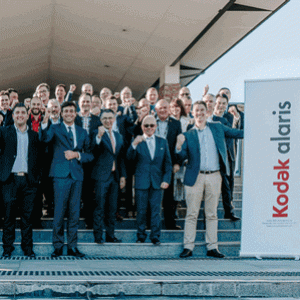
Key international Kodak Alaris executives flew into the NSW Hunter Valley last month for the global imaging giant’s first ANZ partner event in over 10 years. There they were joined by the company’s growing roster of dedicated Australian staff as well as Australian and New Zealand BPOs, resellers and system integrators who experienced an intensive two days showcasing the drive towards Digital Transformation in 2020 and beyond.
Digital transformation is the cyclical hot topic that never dies. It seems that just a few short years ago, if your company was not on a digital transformation journey, it was going to fail spectacularly and everyone should start looking for a new job immediately…
We have seen and understood that customer experience ( and a digital one at that) and the overall experience economy is the current industrial revolution. Now and for the foreseeable future, CX is a key battleground and competitive differentiator.
Decision makers love data. But until recently, organizations have primarily relied on structured data—highly organized data sets that are easy to analyze. Unstructured data, like emails and text, don’t usually follow a predefined model or fit into relational databases. Therefore, a great deal of enterprise data is unstructured, but many organizations may ignore it completely because of the inherent difficulties of analyzing it.
Entering a baby’s health records into a little blue book (in Queensland a little red book) has been a rite of motherhood for many years, but could be consigned to history with the launch of trials of a new Child Digital Health Record (CDHR) in NSW.
A survey of Australia and New Zealand councils who attended KPMG’s public sector network’s local government transformation series in May 2019 has found that digital transformation is often ‘skin deep’, only implemented at the front end.
We are entering the third of three major phases of information management, each increasingly more sophisticated and powerful, and each with new and greater potential to impact a business’s bottom line.
Data intelligence is the foundation of digital transformation—which means there’s a lot riding on the shoulders of today’s IT leaders. In addition to supporting business goals for speed and agility, they must ensure data is properly secured, governed and compliant. Yet this task becomes increasingly complex as the volume of data continues to explode in an ever-changing regulatory environment.