
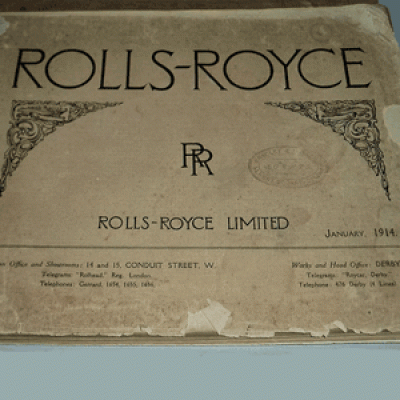
In a quiet corner of Rowville, Victoria, a powerful transformation is underway - one that blends heritage with high-tech precision. The Sir Henry Royce Foundation Australia (SHRF), custodian of a rich archive chronicling the legacy of Henry Royce and the Rolls-Royce movement in Australia, has launched a comprehensive digitisation initiative designed to preserve its irreplaceable records for generations to come.
At the heart of this initiative is a complete scanning solution supplied and installed by Melbourne-based imaging specialists DocuVAN, known for their expertise in archival-grade digitisation across Asia Pacific.
The turnkey setup includes a high-resolution Fujitsu scanner, a robust HP workstation paired with dual 27” monitors for meticulous image review, two 14TB portable drives for redundant storage, and a dedicated uninterruptible power supply (UPS) to safeguard against data loss during power fluctuations.
“Records, photos and documents will be scanned at a quality often better than the original,” remarked SHRF Chairman Brian Crump, underscoring the importance of digital fidelity in preserving fragile documents, photographs, and service records - many of which exist nowhere else.
“This is about confidence. Donors need to know their contributions will be professionally curated and protected.”
Australia is one of three major archives for Sir Henry Royce and his legacy, which includes his whole philosophy around engineering excellence and innovation.
The UK, US and Australia, through charitable Foundations, hold the three major repositories of the considerable archival materials relating to Rolls-Royce and its history.
The Foundation’s archival records collection ranges from books, magazines, brochures, RROCA and Branch historical documentation to service records from Australian Rolls-Royce and Bentley dealers. It includes sales and marketing catalogues dating back to the early 20th Century along with extensive technical information.
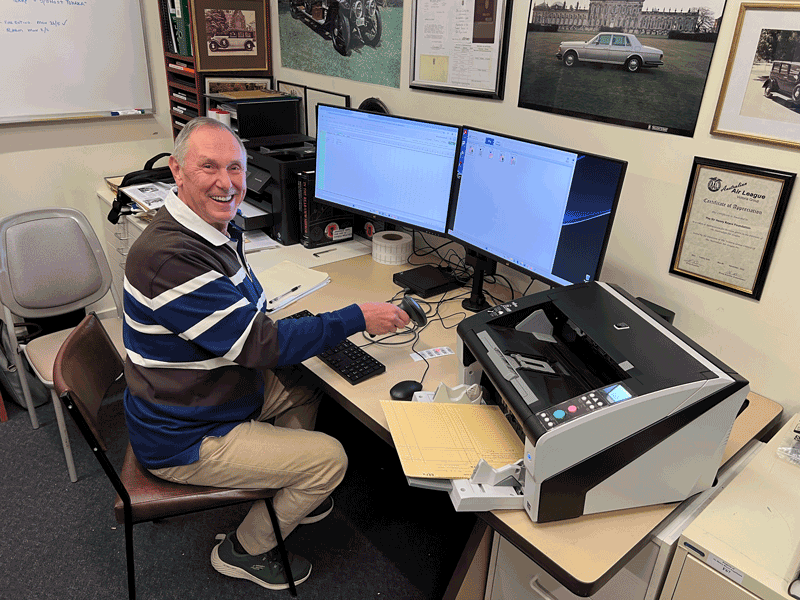
Trustee Howard Wraight’s eye lit up like a kid with a new toy when the SHRF’s new system was installed. “I am really impressed with how easy it all is to operate and how quickly and efficiently the scanner works.”
Trustee Howard Wraight said, “The variability and the diversity of material in our archive in terms of formatting, size and thickness is quite extensive posing a considerable challenge for high-speed scanning. The quantity of materials to be scanned is also a challenge, at a rough guess it’s more than half a million pages that we have to scan.
“Do our records go back to the early 20th Century when the Rolls-Royce Silver Ghost was first made? Not extensively but the market in Victoria, Australia, and particularly Victoria’s Western District, for Rolls-Royce in the early days pre-First World War was quite a big market. We were the third largest market for the company in the world. Obviously, other places have taken over since then, between the war era and certainly post-Second World War.
“We’re not now a very big market for Rolls-Royce at all, but back then they were a very popular car, particularly amongst the wealthy landed gentry in the Western District of Victoria and also in the farming areas of NSW and Queensland, because they were just so well built and virtually indestructible compared to what else was available at the time. And some people were highly cashed up, so a number of cars came out during that period, of which there have been various publications documenting the early history of Rolls-Royce in Australia.
“Most of our extensive service records date from the late 50s through the 60s, 70s and into the 80s. Some of them, especially those coming from the 50s, are starting to look pretty sad and sorry, so it is really urgent that we get those preserved digitally so that they’re not lost.
“We’ve also got more than just service records. We’ve got a very large number of photographs - more than 30,000 photos, which with this new high-resolution scanner we just put the photographs on the scanner and it automatically adjusts to the size and the shape and the material quality and just scans perfectly, so we can digitise all of our photographs as well.”
The Foundation’s archives are a treasure trove of automotive and aero-engine history, including rare publications, technical drawings, and other valuable records. Until now, these materials were vulnerable to environmental degradation and limited in accessibility. With DocuVAN’s solution in place, SHRF can now digitise at scale, ensuring both preservation and discoverability.
“Everything’s going to be scanned to a barcode,” said Wraight. “So, the whole digitised record will sit behind a single barcode within the software that the scanner actually operates on, and then we’re going to copy that across to an Excel database into which we put all the metadata. From searching the metadata, we can identify the original material via the barcode.
“As we load the record into the database, we identify the metadata that we then put in, which for a service record, for example, would be the manufacturer: Rolls-Royce or Bentley, the year of manufacturing, chassis number, the body type, engine number. We’ve got a whole list of all the things that we can enter in, plus also the origin of the service record as well - which company was doing the servicing. If we’ve got delivery dockets we can put all that in as well.
“So, if someone comes along and says, “Look, I’ve just bought a classic Rolls-Royce. I know the chassis number, or I know it’s manufacturer and the body type and year of manufacture. Can you search for it?” We can do that.
“Once we get the process working really well, my vision is to select a couple of members of the Rolls-Royce Owners Club and ask them to volunteer to come and be trained, and we can just have people sitting there quietly scanning away the records on volunteer days. It’s not going to take an inconceivably long period of time. I imagine we’re going to get this all done, knocked over in a year or two.”
“The solution provided by DocuVAN is exactly what the Foundation needed with our limited resources. It is cost effective, user friendly and with the high throughput scanning capabilities it has put the feasibility of digitally preserving our vast collection of historical materials well within our reach, something that did not seem possible until now.”
DocuVAN’s tailored approach reflects a growing trend in heritage institutions embracing digital transformation. Their solutions cater to a wide range of archival needs - from microfilm and fragile records to oversized artwork and books.
The digitisation program also aligns with SHRF’s broader strategic vision, which includes publishing an annual report in 2026 and expanding public access to its collections via electronic platforms.
SHRF Trustee Clare Gordon said, “I am confident that this approach is sustainable and allows the Foundation to be in control of its asset collection material appropriately, capture the documentation in a safe and secure manner and prepare the document collection to be able to be presented for electronic access.”
https://www.henryroycefoundation.com
For more on DocuVAN’s scanning solutions, visit DocuVAN’s official site.