
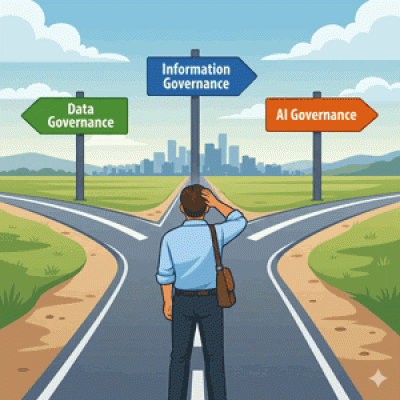
If you've spent any time in governance, you've noticed something: we've been running three separate disciplines that are all trying to solve variations of the same problem. Data governance over here. Information governance over there. And now AI governance is showing up like a new kid at school, expecting everyone to make room.
Each has its own framework. Its own teams. Its own language. And somehow, we're surprised when the business doesn't know the difference between the three.
A Quick History Lesson: Governance didn't start with data. It started with records. Physical documents. Filing cabinets. Retention schedules. Making sure information was stored, retrievable, and destroyed when it needed to be.
Then digital happened. Data governance emerged to manage quality, integrity, lineage, and compliance across structured systems. Information governance continued in parallel — often with different reporting lines and different priorities.
For years, these worlds barely spoke to each other.
But the underlying intent was always the same: make sure information is accurate, accessible, protected, and fit for purpose.
We just kept creating new labels depending on where the information lived.
AI Doesn't Care About Your Org Chart
Here's what's changed.
AI models consume everything — structured data, unstructured documents, policies, emails, internal records. AI doesn't distinguish between a "data asset" and an "information asset." It just learns from whatever you feed it.
This is where things converge fast:
→ Data governance provides the quality, lineage, and classification that AI needs to produce trustworthy outputs
→ Information governance ensures that unstructured information — the stuff AI loves to consume — is properly managed, retained, and destroyed
→ AI governance needs both of these foundations to answer the hard questions: What data trained this model? Is it classified correctly? Who's accountable? Should it have been destroyed already?
And here's what I want to challenge: most AI governance principles aren't actually new. We've been grappling with data ethics, privacy, and responsible use for years. AI governance extends those principles into machine learning and automated decision-making.
If you can't tell me what data trained your model and who's accountable for it — you don't have an AI governance problem. You have a data and information governance problem that AI just made visible.
Enterprise Knowledge Is Not Governance
One discipline that shouldn't be collapsed into governance is knowledge management.
Enterprise knowledge is becoming critical as AI adoption scales. Ontologies, semantic models, and shared business concepts are what turn raw information into something machines and humans can actually reason over.
But this is not governance work. It's data and knowledge management work.
Data and AI governance still have a role to play here. They set the expectations around standards, accountability, and risk for how enterprise knowledge is created and used. But the act of building and maintaining knowledge models? That belongs with the teams managing data and information — not the teams writing policy.
It's an important distinction. Governance sets the guardrails. It doesn't build the road.
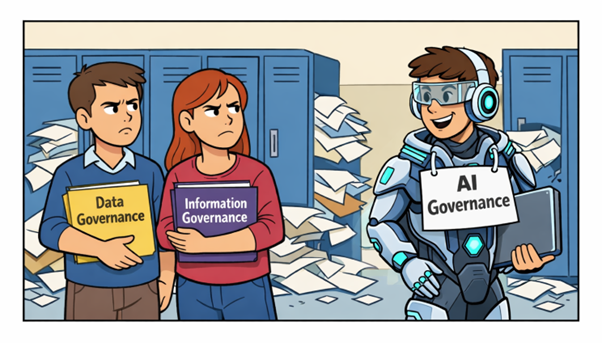
The Convergence Is Already Happening
This isn't a theoretical prediction. It's playing out right now.
Look at the job market. I'm seeing more and more roles with "Data & AI Governance" in the title. Not separate positions — one person expected to span both disciplines. Organisations are already voting with their hiring decisions.
And it makes sense. The person governing your data quality, classification, and lineage is the same person who needs to understand what data is feeding your AI models, how it's being used, and whether it should even be there.
The skills overlap massively. The stakeholders are the same. The risks are connected.
The market is converging these roles faster than our frameworks are keeping up.
Do We Need One Framework or Two?
I'll be upfront, I don't think the answer is clear yet.
Maybe we end up with a single unified governance framework that covers data and AI together. Maybe we keep separate frameworks, a data governance framework and an AI governance framework but they integrate tightly and reference each other.
In practice, I think most organisations will land somewhere in the middle. You'll have your data governance policies covering quality, classification, lineage, and retention. And you'll have AI governance policies covering model oversight, ethics, accountability, and responsible use. But they'll need to work together as a system, not sit in separate folders on SharePoint.
The AI governance framework can't exist without the data governance foundations underneath it. And the data governance framework needs to account for how data is being consumed by AI.
Separate documents? Maybe. Separate thinking? No.
Information Governance and Data Governance Should Merge
I don't see the distinction between information governance and data governance holding much longer.
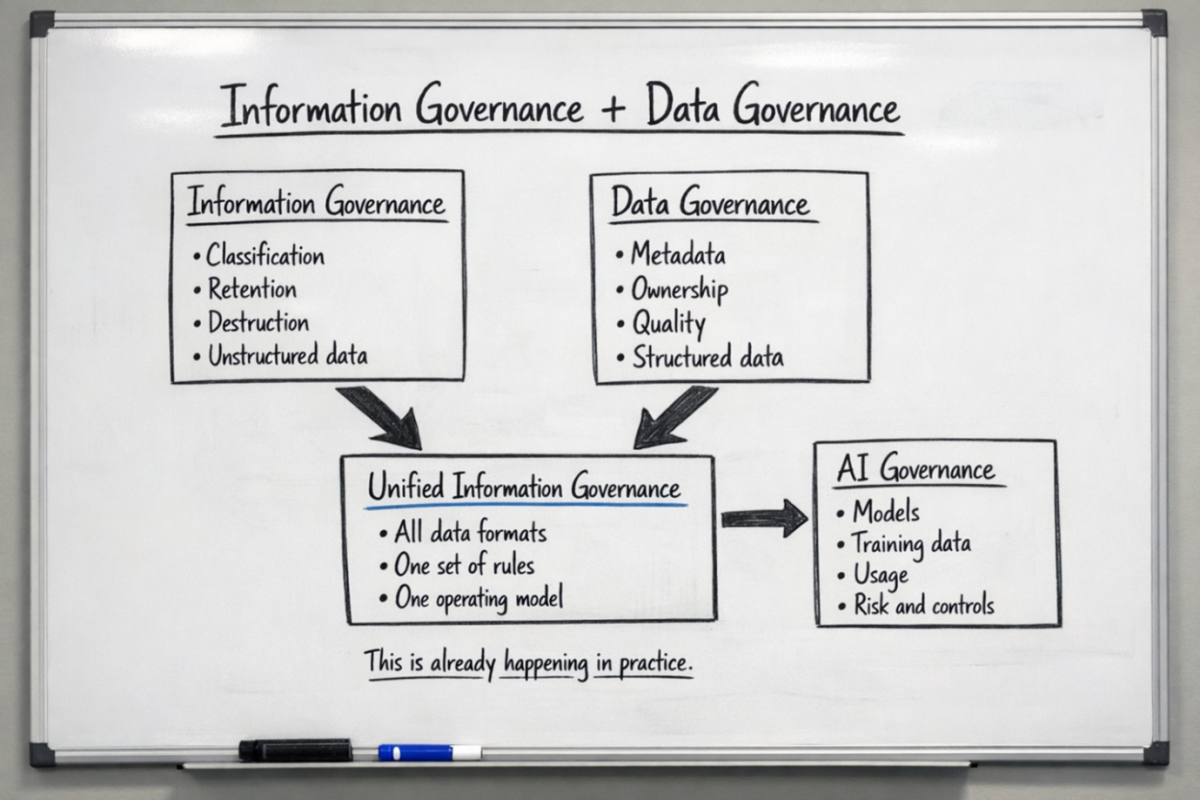
In many organisations, they're already being run together. The same teams handle classification, retention, destruction, metadata, and ownership across structured and unstructured information. The separation often exists in name and reporting lines rather than in day-to-day delivery.
The historical split made sense when data governance was only about structured data in databases and information governance handled everything else. But that line disappeared years ago.
Modern data governance programs manage structured and unstructured data. They handle records retention and destruction. They deal with classification across all information types.
Some organisations will keep the disciplines formally separate for regulatory or organisational reasons. That's fine. But the direction of travel is clear. In practice, these capabilities are converging into a single way of governing information, regardless of format.
Where Does This Leave Us?
The way I see it, we're heading toward two core governance disciplines:
→ Data Governance — covering all information assets, structured and unstructured, including what was traditionally information governance
→ AI Governance — covering model oversight, ethics, accountability, and responsible use, deeply integrated with data governance
Two disciplines. Tightly connected. Possibly one team.
Enterprise knowledge isn't something governance owns — but it's something governance depends on.
The organisations that recognise this convergence early and build for it will move faster and govern more effectively. The ones still running three separate programs with three separate teams will keep wondering why things fall through the cracks.
Chad Barendse is Co-founder of DGX Group, a consultancy dedicated solely to Data and AI Governance. Originally published here