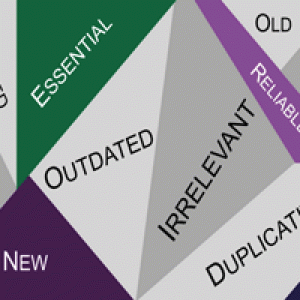
Over my years of consulting, I’ve had the opportunity to strategise, design, and conduct a number of content migration efforts. This is typically in the context of broader content management, document management, or knowledge base redesign or refresh efforts.
While the idea of shifting toward digital business was speculative for most CEOs a few years ago, it has become a reality for many in 2017, according to a recent survey of 388 CEOs by Gartner, Inc
Infosys claims its new Artificial Intelligence (AI) platform, Nia, builds on a year of experience with 50+ clients of its first-generation AI platform, Infosys Mana, and its Robotic Process Automation (RPA) solution, AssistEdge.
We’ve seen what digital transformation can do through the disruption of many consumer and B2B services. Recall the demise of Blockbuster Entertainment’s physical stores when Netflix first delivered movies to mailboxes, then digital streaming directly from TVs and mobile devices. Or the battle taxi services endured when Uber’s ridesharing app reaped market share.
Australian law firm, Corrs Chambers Westgarth, has received a patent from IP Australia for a new optical character recognition (OCR) analysis technology. The technology identifies documents with low quality searchable text and will be used as part of a new service being launched by Corrs called JustOCR.
Funding constraints and legacy infrastructure have been cited as the main barrier to Australian government agencies transitioning to digital information management, according to a report by the National Archives of Australia (NAA).
As nearly every US hospital has an electronic health record system, 41% of surveyed medical record administrators still report struggling with exchanging patient health records with other healthcare providers, particularly physicians not on the same EHR platform. 25% say they are still unable to use any patient information received electronically from external sources.
Prescriptive analytics is about using data and analytics to improve decisions and therefore the effectiveness of actions. Isn’t that what all analytics should be about? A hearty “yes” to that because, if analytics does not lead to more informed decisions and more effective actions, then why do it at all?