
Enterprise attitudes toward artificial intelligence are starting to mature. For the past few years, much of the conversation has centered on increasingly capable AI frontier models: which one is smartest, which benchmark it leads, and which provider appears to have the strongest technology.
But as AI usage moves from experimentation into real operational deployment, another issue is becoming just as important: economics.
A recent Wall Street Journal article highlights the growing pressure on AI model pricing. An onslaught of lower-cost models challenge US frontier providers and force the market to reconsider the relationship between capability and cost. For enterprises, the significance is broader than a simple price war. It reinforces a reality that is already becoming apparent: not every task requires the most powerful model available, and using the same model for every workload is not the most efficient long-term strategy.
A complex reasoning task, a straightforward document classification and a simple summarization request have very different requirements. Paying a premium for all three makes little sense at enterprise scale.
The logical response is a poly-model strategy: use different AI services according to the task, the information being processed, the required level of accuracy, latency, security and cost.
But that creates another problem: Once you use multiple models, how do you manage them as part of a real business operation?
From Model Selection to AI Orchestration
Using several models is relatively straightforward when AI is being tested in isolation. It becomes considerably more complicated when poly-models are embedded across dozens of production processes.
An organization may need to decide which models are permitted to process particular information, where that data can be sent, which service should handle a particular task and what should happen if it fails. It also needs to understand whether an AI-generated response should be accepted automatically, checked against a business rule, validated against another source or passed to a person for review.
Those decisions cannot realistically be buried inside individual scripts and point integrations if AI is going to become a mainstream operational technology.
This is why the architectural conversation is increasingly shifting from model selection to orchestration. The objective is not simply to connect to several AI providers. It is to separate the business process from the technology currently being used to perform a particular task. A process should define what needs to happen; the underlying AI service should be a replaceable component within that process.
That distinction is important because the AI market is changing extraordinarily quickly. Today's premium capability may become commonplace tomorrow. New specialist models will appear, pricing will continue to change, and organizations may need to switch providers because of performance, security, legal data residency or regulatory considerations.
An architecture tightly coupled to a particular AI model risks becoming obsolete almost as quickly as it is deployed.
“The best model for a task used to change every few months. Now it feels like it’s happening multiple times per week.” - - Mike Saeks, quoted in The Wall Street Journal
This Is Where OCTO Delivers
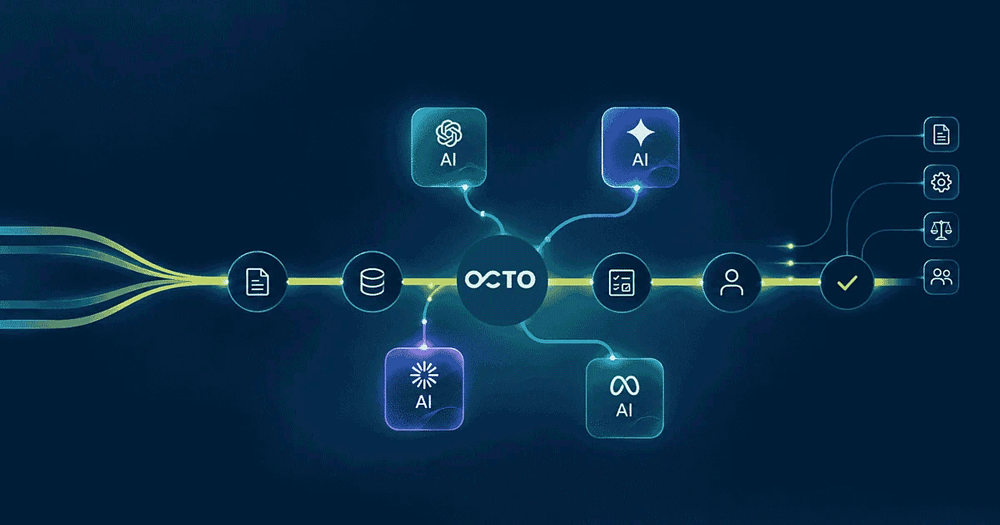
OCTO approaches AI from exactly this perspective. Rather than positioning a particular, monolithic model as the centre of the architecture, OCTO treats AI as one technical capability within a broader end-to-end process. Different models, AI services and deterministic technologies are to be applied at different stages according to what the process actually requires.
That means an organization might use a specialist document-understanding service to interpret an incoming claim, a lightweight language model to classify correspondence, deterministic business rules to verify policy conditions, a more capable model to analyze an unusual exception, and a human reviewer where judgement or additional assurance is required.
The important point is that none of those individual elements has to become the process itself. They participate in the complete process, which is orchestrated by OCTO.
That separation gives organizations much more freedom to change technology over time. If a cheaper model becomes capable to perform a task, it can be introduced without rebuilding the surrounding workflow. If a new specialist AI service produces better results, it can replace the existing component. If a particular workload requires a more powerful model, it can be reserved for those cases rather than becoming the default for everything.
This turns model choice from a strategic commitment into an operational decision.
With Model Intelligence the Cost Savings Potential Is Massive
One of the most important implications of fluctuating AI prices is that organizations can become much more deliberate about where expensive intelligence is actually required.
In many high-volume processes, the majority of transactions are relatively predictable. They may involve classification, extraction, summarization, comparison or straightforward decision support. A smaller proportion of cases require significantly deeper reasoning.
Sending every transaction to the most capable frontier model may therefore be technologically impressive, but economically inefficient.
OCTO allows those distinctions to become part of the process design. Different AI capabilities can be used for different activities, while routing logic, validation rules and process conditions determine what should happen next.
A routine case may pass through a low-cost model and continue automatically. An ambiguous result might trigger additional validation. A high-value or unusual case could be sent to a more capable AI service or presented to a human reviewer.
The objective is not simply to minimize the cost of an individual AI request. It is to use the appropriate level of intelligence at each point in the process. That becomes increasingly important as AI moves into high-volume operational environments, where seemingly small differences in unit cost can become significant when multiplied across millions of transactions.
Model Routing Alone Cannot Solve the Enterprise Problem
There are already several ways to implement multi-model AI. Cloud providers are adding model-routing capabilities, AI gateways provide access to growing catalogues of models, and organizations with strong engineering teams can build their own routing layers. But access and routing alone do not answer the more important question: which model is actually the best fit for a specific requirement? That requires Model Intelligence - the ability to benchmark models against real data and compare quality, cost and latency so that model selection is driven by evidence rather than availability, preference or assumption.
These approaches can be very effective at answering one question:
Which model should handle this request?
But enterprise processes usually involve much more than a sequence of AI calls. Take an insurance claim. Documents and emails arrive through different channels. Information has to be extracted and normalized. Policy and customer systems may need to be queried. Business rules must be applied. AI may interpret unstructured information. External services may need to be called. Exceptions need to be identified and routed. Certain decisions require human involvement, and the final outcome must be recorded before downstream systems are updated.
At that point, model routing is only one small part of the problem, so the more important question becomes:
How should AI participate in the entire business process?
This is the point where broader process orchestration becomes essential. OCTO can orchestrate AI alongside documents, APIs, enterprise systems, business rules, reusable automation activities and people. Rather than creating a separate AI architecture that then has to be connected back into operational processes, AI becomes part of the same process model used to manage the work itself.
That distinction may sound subtle. In practice, it's the difference between integration and true transformation.
AI Output Produces Just Raw Data – Not Business Decisions
There is another very important reason why orchestration matters. More AI choice does not automatically mean trustworthy AI. Even highly capable models may produce inconsistent or incorrect results. As organisations increase their use of AI, the need for control and traceability becomes more important rather than less.
A robust enterprise process therefore needs to determine not only which AI model is used, but what happens to its output.
Within OCTO, an AI response is typically treated as one input into a controlled process rather than as an unquestioned decision. Results can be tested against deterministic validation rules, compared with other information, passed through additional processing or routed to a person where review is appropriate.
This combination of AI, business logic and human judgement is particularly important in document-heavy and regulated processes, where an incorrect answer can have consequences far beyond the cost of the original model call.
Human-in-the-loop processing also does not have to mean reviewing everything. The process can determine where human involvement adds value, allowing routine and sufficiently reliable cases to continue automatically while exceptions receive additional attention.
That makes the human role more targeted, while still providing the control required for production AI.
The Real Cost Is the Cost of The Process
The current focus on model pricing can also encourage organizations to optimize the wrong metric.
The cheapest model per token is not necessarily the model that delivers the best overall value. A lower-cost service may produce weaker results, take longer to process, or create more downstream review effort. Equally, a more expensive model may justify its cost if it consistently produces higher-quality outcomes.
This is why OCTO looks beyond price alone. Its AI benchmarking capabilities bring data quality, processing performance, and cost into a single comparative view, allowing organizations to test multiple models against the same workload and understand the trade-offs between them. Rather than selecting a model because it is simply the cheapest or the most accurate, teams can see which option delivers the strongest overall return - effectively, which model gives them the most bang for the buck.
That comparison is especially valuable because the answer will not always be the same for every use case. One model may offer the best balance for high-volume classification, while another justifies a higher cost for complex extraction tasks. By benchmarking models against real process requirements, organizations can make those decisions based on evidence rather than reputation, headline pricing, or benchmark scores taken out of context.
Combined with OCTO's orchestration capabilities, this turns AI model selection into an ongoing operational discipline. Organizations can benchmark alternatives, identify where better value is available, and then introduce the most appropriate model into the process without redesigning the surrounding workflow.
The result is not simply lower AI spend. It is a clearer and demonstrable understanding of which model delivers the best combination of quality, speed, and cost for the job that actually needs to be done.
Avoiding the Next Generation of AI Lock-In
There is also a longer-term architectural consideration. The danger with the current rush to deploy generative AI is that organizations recreate an old problem using new technology. Individual teams connect directly to different AI providers, prompts become embedded in applications, logic becomes tied to specific APIs and the organization gradually accumulates a portfolio of point integrations that increases technical debt and become difficult to change.
The result may be multi-model AI in theory but considerable vendor dependency in practice.
OCTO provides a layer of abstraction between the business process and the underlying technologies. AI models can change while the process remains intact. Integrations and activities can be reused. Validation and governance can be applied consistently. New services can be introduced without redesigning the entire process solution around them.
This does not eliminate integration work, nor does it mean every technology can be replaced instantly. What it does is significantly reduce the degree to which the business process becomes dependent on the implementation details of any individual AI provider.
As the AI market continues to move at speed, the ability to change models quickly and painlessly won't be a nice-to-have. It will be a competitive necessity.
Change AI Models – Not The Process
Perhaps the most important implication of the current AI price competition has little to do with price itself. AI is becoming a normal enterprise technology component.
Organizations already accept that different databases, integration technologies, cloud services and specialist applications have different strengths. AI is likely to develop in much the same way.
Enterprises are unlikely to rely on just one model for everything. Instead, organizations will assemble combinations of frontier models, smaller models, specialist AI services, deterministic software, enterprise data and human expertise around particular business outcomes. That changes the strategic question…
It is no longer simply:
Which AI platform should we standardise on?
It becomes:
How do we create an operating environment in which we can continually use the right combination of (AI) technologies?
That is where OCTO's proposition becomes especially compelling.
OCTO is not asking organizations to predict which AI provider will ultimately win. It provides the orchestration and processing layer that allows them to take advantage of whichever models, services and technologies are best suited to the process - while maintaining the workflow, governance, integrations and human involvement around them.
As access to capable AI becomes cheaper and more widespread, competitive advantage increasingly moves higher up the stack. The differentiator is less about having access to intelligence and more about how effectively that intelligence is connected to the business.
The organizations best positioned for the next phase of enterprise AI may therefore not be those that choose the winning model. They will be the ones that can change models without changing the business flow.
That is the role process orchestration must play - and it is exactly the role OCTO exists to fulfil.
Arnold von Büren is CEO, TCG Process.