Businesses globally face a “digital ceiling” when it comes to digital transformation, according to new research from Infosys Knowledge Institute (IKI), the thought leadership and research arm of Infosys. The study reveals that businesses must change their mindsets to achieve sophisticated levels of digital maturity.
As supply chains become more global and complex, processes are becoming increasingly challenging to monitor and optimize. Identifying the root cause of inefficiencies can prove difficult without having a comprehensive view of operational workflows.
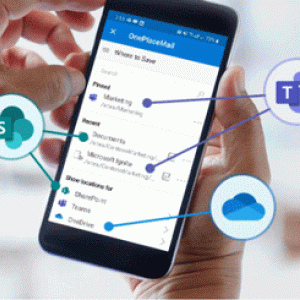
Your organisation has likely gotten caught up in the world-wide trend of migrating to Office365 and SharePoint on-line. In doing that you have probably had conversations with various IT staff where you’ve heard words and phrases like: “Teams, Dynamic Groups, Channels, AIP, Flow, LogicApps, PowerApps, evergreen” to the point where it sounds like English, but you have no idea what they’re talking about, let alone understanding the risks and advantages.
Hacking into voting machines remains far too easy. It is too soon to say for sure what role cybersecurity played in the 2020 Iowa caucuses, but the problems, which are still unfolding and being investigated, show how easily systemic failures can lead to delays and undermine trust in democratic processes. That’s particularly true when new technology – in this case, a reporting app – is introduced, even if there’s no targeted attack on the system.
It has become increasingly common for documents to be signed electronically. This can be a very convenient way of signing and storing documents. However, there are more and more cases where electronic signatures are being challenged, and documents being considered unenforceable as a result.
On the eve of this new decade, it is worth reflecting on what has truly been one of the most talked about, exciting and challenging business transition of the 2010s, digital transformation.
Digital transformation of an organisation is a complex undertaking that involves a change in culture that is more profound than both the technical and process changes combined.
The Australian government’s Digital Transformation Agency (DTA) has spent more than A$200 million over the past five years developing a National Digital ID platform. If successful, the project could streamline commerce, resolve bureaucratic quagmires, and improve national security. The emerging results of the project may give the Australian public cause for concern.
How can your organisation demonstrate that it has taken the appropriate steps to ensure data management is under control and customer data and third-party information is secure?
The ISO standard 15489, clearly and succinctly defines a record as evidence of a business transaction and also clearly says that a record is a record regardless of media. This means that the business of records management includes the management of all types of records including paper, electronic documents, images and emails. Email Management is an essential part of Records Management.