
Who’s the hero? What Iron Man teaches us about AI

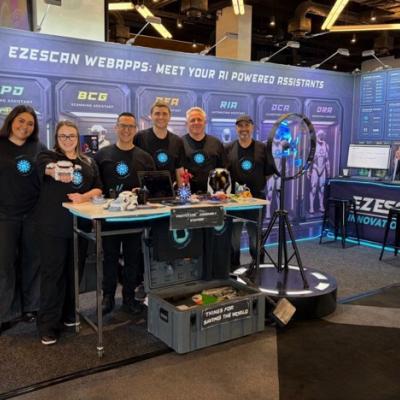
EzeScan team at RIMPA Live
The EzeScan team at RIMPA Live 2026.

AI is often discussed in terms of what it might replace. But perhaps we’re asking the wrong question. What if its real value is not replacing human expertise, but extending what skilled people are capable of?

Who is the hero of Iron Man?

Most people would probably point to the red-and-gold armoured figure flying across the screen. It’s the suit that delivers superhuman strength, analyses threats, fires weapons and, of course, gets all the attention.

But is the suit really the hero?

That question inspired our recent EzeScan exhibition stand at RIMPA Live 2026. As we explored the relationship between Tony Stark, his suit and JARVIS, we recognised an interesting parallel with AI and information management.

Technology can dramatically extend what people are capable of. But it doesn’t replace the knowledge, experience and judgement they bring.

For anyone who missed it, or has simply forgotten, Iron Man (2008) introduced audiences to Tony Stark, a brilliant engineer who creates a powered suit of armour. What begins as a crude means of escape evolves into an extraordinarily sophisticated system capable of flight, advanced combat and real-time analysis.

Alongside the suit is JARVIS, Stark’s AI assistant. JARVIS continuously analyses information, monitors threats, identifies problems and provides recommendations.

But there’s something important about that relationship.

Stark himself has no superpowers. He cannot fly. He has no superhuman strength. He certainly can’t fire energy beams from his hands. What he does have is knowledge, creativity, experience and an extraordinary ability to solve problems.

The technology amplifies those abilities.

And, crucially, Stark remains the decision-maker. JARVIS might identify the threat. The suit might provide the capability to respond. But Stark decides what to do, and Stark is accountable for what happens next.

That is how we believe information professionals should think about AI.

The technology assists. The human provides the context, direction, judgement and accountability.

AI should help us think, not think for us

It’s how most of us use AI ourselves. We use it to explore ideas, analyse information and challenge our thinking, but we don’t simply accept everything it tells us.

Sometimes it’s right. Sometimes it misses something important. And sometimes it’s spectacularly wrong.

We question it. We refine it. We apply our own knowledge and experience.

AI isn’t there to think for us. It’s there to help us think better.

For records and information professionals, that distinction matters.

Records managers and information governance teams are responsible for ensuring information can be trusted, sensitive content is appropriately protected, records remain discoverable, and retention and disposal obligations are met.

Those responsibilities require something software cannot provide on its own: an understanding of your organisation and the context in which its information exists.

Yet how much of your time is actually spent applying that expertise?

Processing documents, entering metadata, classifying records, searching repositories, checking content and tracking down information that has been misfiled, poorly described or simply forgotten are all necessary tasks.

But are they really the best use of an information professional’s expertise?

Imagine 1,000 documents landing on your desk

Imagine we handed you 1,000 documents and asked you to read every one.

Identify what each document is. Extract the important information. Classify it. Determine where it belongs. Check whether it contains sensitive information. Flag anything that looks unusual.

You could do it. But why would we want you to?

Traditional capture technologies have been helping organisations reduce this burden for years through OCR, pattern recognition, data extraction, barcodes and predefined business rules.

AI changes the equation because it gives us new ways to make sense of unstructured information.

Rather than simply asking, “What text is on this page?”, we can increasingly ask:

What is this? What does it contain? Why might it matter? Is there something here we should be concerned about? And what should happen to it next?

AI can help identify document types, extract critical information, classify records and detect potentially sensitive content across large volumes.

Combined with automation and well-defined business rules, much of that repetitive work can happen without somebody having to inspect every document.

And that changes where the human effort goes.

Instead of asking information professionals to find every needle in the haystack, technology can help find the needles and bring them to you.

You can then concentrate on what deserves your expertise: the exceptions, the risks, the unusual cases and the decisions that genuinely require human judgement.

“Instead of asking information professionals to find every needle in the haystack, technology can help find the needles and bring them to you.”

That’s where AI gets interesting

At EzeScan, we don’t think the most interesting question is:

“Will AI replace the information professional?”

We think a much better question is:

“What could information professionals achieve if technology did more of the work that doesn’t require their expertise?”

That’s how we think about our own solutions. We’re not trying to build a replacement for the information professional. We’re building the suit.

Our EzeScan WebApps are designed to extend the capabilities of the people responsible for managing information. Underneath them is an intelligence layer that brings together AI, automation and the business rules defined by the organisation.

Like the capabilities built into Iron Man’s suit, each WebApp has a different mission.

Remote Indexing Assistant (RIA) takes on repetitive indexing and filing after digitisation, helping identify documents, apply appropriate metadata and send them to the required destination.

Document Classification Assistant (DCA) helps make sense of incoming information, identifying document types, classifying content and directing it into the appropriate process.

Document Repository Analyser (DRA) looks at the information you already have, helping uncover what exists within repositories and identify potentially sensitive or inappropriately stored content.

Barcode Coversheet Generator (BCG) connects physical records with digital processes, using barcode coversheets to identify document batches and determine where captured information should go.

Digital Forms Assistant (DFA) moves information capture closer to the point of creation, replacing paper forms with structured digital interactions and automated processing.

Data Panel Dashboard (DPD) provides visibility across those processes, helping teams understand what is happening, what is waiting and where human attention may be required.

Different capabilities. Different missions. But the principle is the same:

The technology does the heavy lifting. The information professional provides the context, sets the direction and makes the decisions.

So, who’s the hero?

Just as Tony Stark needs more than a suit to become Iron Man, information professionals need more than AI to achieve better outcomes.

The real value comes from the combination.

Technology brings scale, speed and processing power. People bring knowledge, experience, context and judgement.

As information volumes continue to grow and expectations around governance, privacy, security and accessibility increase, perhaps we need to change the way we talk about AI.

Instead of asking:

“What will AI take away from my role?”

ask:

“What could I achieve if technology could take my expertise further?”

Because the hero isn’t the most sophisticated technology.

It isn’t the smartest AI. And it isn’t the suit.

It’s the information professional who understands the information, the risks, the context and the mission.

At EzeScan, we’re not trying to build a better hero. We’re building better suits for the heroes already out there.

Amanda Gunther is Operations Manager at EzeScan.